As it’s Aromantic Awareness week we thought we’d check out some books that feature aromantic storylines or characters. It turns out there is quite a number. We’ve found 5 well-rated audio and kindle books for you to read/listen to.
“The Lady’s Guide to Petticoats and Piracy” by Mackenzi Lee: This is a young adult historical fiction novel that features a protagonist who is aromantic and asexual.
“Every Heart a Doorway” by Seanan McGuire: This is a fantasy novel that features several characters who are aromantic, asexual, or both.
“The Life and Death of Sophie Stark” by Anna North: This is a literary novel that features a protagonist who is asexual and aromantic.
“The Cybernetic Tea Shop” by Meredith Katz: This is a science fiction novella that features a protagonist who is asexual and aromantic.
“Clariel” by Garth Nix: This is a young adult fantasy novel that features a protagonist who is aromantic.
“Aromanticism” by Sarah Schulman: This is a non-fiction book that explores the social, cultural, and historical factors that have contributed to the erasure of aromanticism as a valid identity.
“Not Your Villain” by C.B. Lee: This is a young adult superhero novel that features a protagonist who is aromantic and transgender.
“The Black Tides of Heaven” by J.Y. Yang: This is a novella that features a protagonist who is genderqueer, asexual, and aromantic.
“Mask of Shadows” by Linsey Miller: This is a young adult fantasy novel that features a protagonist who is genderfluid, asexual, and aromantic.
“Loveless” by Alice Oseman: This is a young adult novel that features a protagonist who is asexual and aromantic.
“The Ace of Spades” by Faridah Àbíké-Íyímídé: This is a young adult thriller that features a protagonist who is asexual and aromantic.
These are just a few examples, and there are likely many more books that feature aromantic characters or explore themes related to aromanticism. It’s important to note that while representation in media is important, each individual’s experience of aromanticism is unique, and not all aromantic individuals may identify with the way that aromanticism is portrayed in fiction.
It’s difficult to estimate the number of people who identify as aromantic because it is a relatively new concept and the term is still gaining awareness and recognition. However, there is a growing awareness and acceptance of aromanticism, and more people are identifying as aromantic or on the aromantic spectrum.
Some studies have suggested that a significant number of asexual people also identify as aromantic, and some studies have shown that asexuality is more common than previously thought. However, not all aromantic individuals may identify as asexual, and not all asexual individuals may identify as romantic.
It’s important to note that while aromanticism may not be as well-known as some other identities, it is a valid and important aspect of a person’s identity, and everyone deserves to have their identity respected and accepted.
Non-monogamous gay relationships refer to relationships where the partners involved agree to engage in sexual or romantic relationships with other people outside of their primary relationship. This type of relationship is also sometimes referred to as polyamorous or open relationships.
Non-monogamous gay relationships can take various forms, from open relationships where partners have casual sexual encounters with other people, to more serious and committed polyamorous relationships where partners have multiple romantic relationships at the same time.
As with any relationship, communication and mutual consent are essential in non-monogamous gay relationships. It’s important for partners to have open and honest conversations about their expectations, boundaries, and feelings regarding non-monogamy. Additionally, it’s important for partners to practice safe sex and to be transparent with each other about any other sexual partners they may have.
It’s worth noting that non-monogamous gay relationships may not be for everyone, and that’s okay. Every relationship is unique, and what works for one couple may not work for another. Ultimately, it’s up to each individual and couple to decide what type of relationship structure works best for them.
How do I honor multiple partnerships in a non-monogamous relationship?
Honoring multiple partnerships in a non-monogamous relationship involves treating each partner with respect, consideration, and honesty. Here are a few tips to help you navigate multiple partnerships:
Practice open and honest communication: Be transparent with your partners about your feelings, desires, and boundaries. Make sure each partner is aware of the other(s) and feels comfortable with the non-monogamous arrangement.
Respect each partner’s individuality: Each of your partners is a unique individual with their own needs, desires, and boundaries. Take the time to get to know each partner on a personal level and show them that you care about their individual wants and needs.
Prioritize safety and health: Practice safe sex with all partners and get tested regularly for sexually transmitted infections (STIs). Be open and honest about your sexual activity with all partners, and encourage them to do the same.
Be considerate of your partners’ time: Make sure to allocate time for each partner and be respectful of their schedules and commitments. Communicate clearly about your availability and prioritize quality time with each partner.
Avoid comparison and competition: It’s important to resist the temptation to compare partners or compete for attention. Each partner brings something unique to the relationship, and it’s important to appreciate and value each partner for their individual qualities and contributions.
Ultimately, honoring multiple partnerships in a non-monogamous relationship requires a strong foundation of communication, mutual respect, and empathy. By putting in the effort to build these qualities, you can create fulfilling and meaningful relationships with multiple partners.
Do lots of gay men have non-monogamous relationships?
It’s difficult to determine the exact percentage of gay men who have non-monogamous relationships, as there are no comprehensive studies on this topic. However, it’s safe to say that non-monogamous relationships are not uncommon in the gay community, and there is a growing awareness and acceptance of non-monogamy as a valid relationship option.
Some surveys and studies have found that non-monogamy is more prevalent in the LGBTQ+ community than in the general population. For example, a survey conducted by The Advocate in 2017 found that nearly half of the LGBTQ+ respondents reported being in a non-monogamous relationship, compared to only 4% of the general population in a similar survey. However, it’s important to note that these surveys and studies may not be representative of the entire LGBTQ+ community, and that attitudes towards non-monogamy can vary widely among individuals.
It’s also worth noting that non-monogamy is not for everyone, and that there is no “right” or “wrong” way to structure a relationship. Every relationship is unique, and what works for one couple may not work for another. Ultimately, it’s up to each individual and couple to decide what type of relationship structure works best for them.
What happens if multiple partners want to spend the day together?
If multiple partners want to spend the day together in a non-monogamous relationship, it’s important to communicate openly and honestly with all parties involved. Here are some possible ways to handle this situation:
Schedule time with each partner: If multiple partners want to spend the day together, you can try scheduling separate time with each partner. This allows you to give each partner the attention they deserve and avoid making anyone feel left out.
Invite all partners to spend time together: Depending on the relationship dynamics and personalities of the individuals involved, you may be able to invite all partners to spend time together. This can be a great way to build stronger connections and create a sense of community within the non-monogamous relationship.
Prioritize the partner you have plans with: If you have already made plans with one partner, it’s important to honor those plans and not cancel at the last minute to spend time with another partner. This shows respect and consideration for your partner’s time and feelings.
Be flexible: Sometimes unexpected situations arise, and plans may need to be adjusted. It’s important to be flexible and understanding when this happens and to communicate openly with all partners involved.
Overall, the key to navigating this situation is to communicate openly and honestly with all partners involved, and to prioritize everyone’s needs and feelings. By being considerate and respectful of each partner, you can create a harmonious and fulfilling non-monogamous relationship.
Determining if you’re gay or not can be a personal and sometimes complex process.
Table of Contents
Here’s how you can determine if you’re gay or not
However, here are a few things you can consider as you explore your sexuality:
Examine your attractions: Take note of who you are attracted to and who you find yourself thinking about romantically and/or sexually. Do you find yourself attracted to people of the same gender as you?
Explore your feelings: Consider your emotions and how you feel about your attractions. Are you comfortable with them, or do they make you feel confused or uncomfortable?
Reflect on your experiences: Think about your past and current romantic and/or sexual experiences. Have you had feelings for someone of the same gender, or have you ever acted on those feelings?
Avoid stereotypes: Don’t rely on stereotypes or assumptions about what it means to be gay or straight. Everyone’s experiences and feelings are unique.
It’s important to remember that there is no rush to label yourself, and your sexual orientation can be fluid and change over time. Ultimately, it’s up to you to determine what feels right and true for yourself. If you’re struggling to understand your feelings, it might be helpful to talk to a therapist or a trusted friend or family member.
Do gay people suffer in the UK?
Like in any country, the experiences of LGBT+ people in the UK can vary depending on a range of factors such as their location, age, cultural background, and individual circumstances. While there have been significant legal advances for LGBT+ rights in the UK, discrimination and violence against LGBT+ individuals still occur.
The UK has made significant progress in terms of legal protections for LGBT+ people. Same-sex marriage has been legal in England, Scotland, and Wales since 2014, and Northern Ireland legalized same-sex marriage in 2020. Discrimination on the basis of sexual orientation is illegal in employment, education, and the provision of goods and services. Transgender people in the UK have legal protections under the Gender Recognition Act of 2004, which allows them to change their legal gender.
However, despite these legal protections, some LGBT+ people in the UK still face discrimination, harassment, and violence. Hate crimes against LGBT+ individuals have been on the rise in recent years. According to Stonewall, a leading LGBT+ rights charity in the UK, one in five LGBT+ people has experienced a hate crime or incident in the past year.
Moreover, research has shown that LGBT+ individuals in the UK are more likely to experience mental health issues such as depression and anxiety. This can be attributed to a range of factors including discrimination, stigma, and social isolation.
In summary, while there have been significant legal advances for LGBT+ rights in the UK, discrimination and violence against LGBT+ individuals still exist, and many LGBT+ people in the UK continue to face unique challenges and struggles.
No, you do not have to like anal sex if you are gay. Sexual preferences and desires are unique to each individual, regardless of their sexual orientation. Some gay men enjoy anal sex, while others do not, and that is completely normal and acceptable. It’s important to remember that sexual activity should always be consensual and based on what feels comfortable and enjoyable for all parties involved. Communication with sexual partners is key to ensuring that everyone’s needs and boundaries are respected. If you are unsure about what you like or don’t like, or if you are experiencing discomfort or pain during sexual activity, it may be helpful to talk to a healthcare provider or a sex therapist for guidance and advice. Ultimately, the most important thing is to prioritize your own well-being and pleasure in sexual experiences, regardless of whether or not they include anal sex.
Do I Have to tell my family if I’m gay?
The decision to come out as gay is a deeply personal one, and it’s ultimately up to you to decide whether or not to share this information with your family. Coming out can be a difficult and emotional process, and it’s important to consider your own safety and well-being as well as the potential impact that coming out might have on your relationships with your family members.
While coming out can be a positive experience for some, it’s important to remember that not everyone will react positively or supportively. Some families may struggle to accept their loved one’s sexuality due to deeply held beliefs or cultural attitudes, which can lead to difficult conversations or strained relationships. It’s important to be prepared for a range of possible reactions and to prioritize your own safety and well-being.
If you do decide to come out to your family, consider starting with a trusted family member or friend who you believe will be supportive. This can provide you with a support system as you navigate the process of coming out and potentially help you prepare for conversations with family members who may be less supportive.
Remember that there is no one right way to come out, and the timing and approach will depend on your individual circumstances. You may want to seek out support from a therapist, a support group, or an LGBT+ organization as you navigate this process. Ultimately, the decision to come out is a personal one, and it’s important to prioritize your own safety and well-being.
Trigender is a unique gender identity that has been gaining traction in recent years. It is a nonbinary gender identity that incorporates elements of three distinct genders – male, female, and a third nonbinary gender. For those unfamiliar with this concept, this article will explore what it means to identify in this way, who can be Trigender, and why it is an important part of the conversation surrounding gender identity.
What is Trigender?
Trigender is an increasingly recognized gender identity that falls on the gender spectrum. It is often defined as a combination of three gender identities, which may include male, female, agender, genderfluid, gender nonconforming, and/or any other non-binary gender identity. Unlike transgender people, who identify as a different gender than their assigned sex at birth, Trigender individuals identify as three genders or as part of a multi-gendered experience.
Trigender is distinct from being genderfluid in that it is not limited to just two gender identities; rather, it involves three or more genders that come together to form an individual’s gender identity. By recognizing the complexity of gender, individuals are able to express themselves authentically and find acceptance for who they are.
How is Trigender Different from other Gender Identities?
This gender identity is a distinct gender identity which is seen as different from both binary transgender and non-binary identities. While it shares similarities with both, it has its own distinct set of characteristics.
Trigender people have a gender identity that is fluid, meaning that they don’t identify with any one gender over another. Instead, they experience a combination of genders, or in some cases, all genders. This may include male, female, and non-binary identities. Trigender people experience their gender as constantly changing and fluctuating, as opposed to identifying solely with one gender.
The gender spectrum is an important concept for understanding trigender people. This spectrum allows people to identify along a range of genders and gender expressions, from male at one end to female at the other end, with non-binary in between. Trigender people can exist at any point along this spectrum, and may even move between multiple points on the spectrum throughout their lifetime.
Overall, it is a unique gender identity which encompasses multiple gender identities and expressions. It is important to recognize the uniqueness of this identity and to support those who identify as trigender.
Who Can Be Trigender?
Trigender is a unique gender identity that refers to those who identify with three genders simultaneously. This can include identifying as transgender, non-binary, or somewhere else on the gender spectrum. It’s important to note that one’s identity can be fluid and may change over time, so it is possible to identify as trigender at some points in life and not others.
Individuals may experience a combination of feminine, masculine, and/or non-binary qualities. This could mean feeling like a mix of all genders, feeling neutral, feeling like none of the genders, or feeling like one gender more than the others. Everyone experiences their gender differently, so it is important to remember that there is no one definition of what it means to be trigender.
If you know someone who identifies as trigender, it is important to remember that there is no “right” or “wrong” way to be trigender. Respect and acceptance are key to supporting your friend or family member. Be open-minded and understanding, and allow them the space to express themselves in whatever way they feel comfortable.
What Are the Common Experiences of Trigender Individuals?
Trigender individuals are unique in their gender identity, and their experiences may be different from those who identify as transgender, non-binary, or any other gender. That said, there are some common themes among trigender individuals that can be helpful to understand.
First, it’s important to recognize that many people who identify as trigender often have a very fluid understanding of their gender identity. Many people who identify as trigender don’t feel the same way all the time, and this can lead to shifts in the way they express their gender identity at any given time. This is something that trigender individuals often experience and it’s important to recognize this when interacting with someone who identifies as trigender.
Another common experience among trigender individuals is feeling as though they do not fit into traditional gender roles or expectations. Trigender individuals may feel like they do not conform to either male or female stereotypes or roles, and instead feel that they occupy a space somewhere in between the two. This is an important aspect of their identity that should be respected.
Finally, it’s important to recognize that for many trigender individuals, the gender spectrum is not simply black and white. They may identify with multiple genders, or exist somewhere between genders, and it’s important to recognize and respect this. Trigender individuals often find themselves existing on multiple points of the gender spectrum at the same time, so it’s important to stay open-minded and to understand that everyone’s experience is unique.
How Can I Support a Trigender Friend or Family Member?
When a friend or family member identifies in this way, it is important to show support and understanding. Here are some tips on how to best support someone who identifies as Trigender:
1. Listen and Respect: It is important to allow them to express their identity without judgment or criticism. Respect their choice of pronouns and be mindful of language.
2. Education: Become educated on the gender spectrum, non-binary identities, and Trigender in particular. This will help you understand better what your friend or family member is going through and will help you to become a better support system for them.
3. Offer Support: Individuals may face a lot of adversity and judgement from society. Offer support to your friend or family member by providing a safe space and being an ally.
4. Celebrate: Celebrate your loved one’s identity with them! Celebrating their unique identity can make them feel more accepted and supported.
By following these tips, you can provide a safe and understanding environment for your friend or family member who identifies as as this gender identity. With your support, they can feel accepted and empowered.
Section 28 was a controversial provision of the Local Government Act 1988 in England, Wales, and Scotland, which stated that a local authority “shall not intentionally promote homosexuality or publish material with the intention of promoting homosexuality” or “promote the teaching in any maintained school of the acceptability of homosexuality as a pretended family relationship.”
Table of Contents
When was section 28 enacted?
This provision, which was introduced during the conservative government of Margaret Thatcher and remained in force during the government of John Major, was widely criticized by LGBTQ+ rights activists, educators, and progressive politicians. They argued that the provision contributed to a culture of discrimination and prejudice against LGBTQ+ individuals, and had a chilling effect on the ability of schools and other organizations to provide support and resources to lesbian, gay and bisexual individuals.
Section 28 was eventually repealed in Scotland in 2000, and in the rest of the UK in 2003. Its repeal was seen as a significant victory for gay rights advocates, and paved the way for greater acceptance and legal recognition of the LGBTQ+ community in the UK.
In Scotland, the provision known as “Section 28” was officially called Section 2A of the Local Government Act 1986, which was passed by the UK government under the leadership of Prime Minister Margaret Thatcher.
Section 2A was identical to Section 28, which was introduced in England, Wales, and Northern Ireland by the Local Government Act 1988, during the same period of time. The provisions prohibited local authorities from “promoting homosexuality” or teaching “the acceptability of homosexuality as a pretended family relationship.”
The section 2A provision was ended in Scotland before the rest of the UK, as it was repealed in 2000, two years before it was repealed in the rest of the country. The repeal of Section 28 in Scotland was seen as a significant victory for LGBTQ+ rights advocates, and paved the way for greater acceptance and legal recognition of the LGBTQ+ community in Scotland.
When was section 28 scrapped?
Section 28, a controversial provision of the Local Government Act 1988 in the United Kingdom that prohibited the promotion of homosexuality in schools and local authorities, was repealed on 18th November 2003. The repeal of Section 28 was a significant moment in the history of LGBTQ+ rights in the UK, and was widely celebrated by LGBTQ+ rights advocates and progressive politicians.
The repeal of Section 28 followed years of campaigning by LGBTQ+ rights activists, who argued that the provision contributed to a culture of discrimination and prejudice against LGBTQ+ individuals, and had a chilling effect on the ability of schools and other organizations to provide support and resources to LGBTQ+ individuals.
The repeal of Section 28 was seen as a significant step forward for LGBTQ+ rights in the UK, and paved the way for greater acceptance and legal recognition of the LGBTQ+ community. However, it is important to note that despite the repeal of Section 28, LGBTQ+ individuals in the UK still face discrimination and prejudice in many areas of life, and there is still work to be done to ensure full equality for all members of the community.
John Major, who served as the Prime Minister of the United Kingdom from 1990 to 1997, had a mixed record when it comes to LGBTQ+ rights. While he did not openly express anti-gay views, he did not actively support gay rights during his time in office.
Table of Contents
Section 28
During Major’s tenure as Prime Minister, the Section 28 of the of the Local Government Act 1988 remained in power after being introduced by John Major’s predecessor Margaret Thatcher. This provision prohibited local authorities from promoting homosexuality, and had a chilling effect on the ability of schools and other organizations to provide support and resources to LGBTQ+ individuals. Major initially supported the provision, but later indicated that he regretted it.
In addition, Major’s government maintained a number of discriminatory measures against LGBTQ+ individuals, including a ban on gays and lesbians serving in the armed forces, and a refusal to recognize same-sex relationships for the purposes of immigration.
Overall, while Major did not explicitly express anti-gay views, his record on LGBTQ+ issues during his time as Prime Minister was not supportive of the community. It is worth noting, however, that Major has expressed regret for some of the policies that remained during his time in office, and has since spoken out in support of LGBTQ+ rights.
During John Major’s tenure as Prime Minister of the United Kingdom from 1990 to 1997, his government decided to keep several laws and policies that discriminated against LGBTQ+ individuals.
One of the most controversial laws during Major’s time in office was Section 28 of the Local Government Act 1988, which prohibited local authorities from “promoting homosexuality” or teaching “the acceptability of homosexuality as a pretended family relationship.” This provision had a chilling effect on the ability of schools and other organizations to provide support and resources to LGBTQ+ individuals. Section 28 was eventually repealed in 2003.
Gay Ban In the Military
In addition, during Major’s time in office, the government continued to ban LGBTQ+ individuals from serving in the armed forces. This ban, known as the “gay ban,” was not lifted until 2000.
Reducing the age of consent
During this time, the UK’s government did vote to reduce the age of consent for gay sex from 21 to 18.
The age of consent for gay men in the UK was reduced from 21 to 18 on November 30, 1994, under the government of Prime Minister John Major. This change in the law was part of the Criminal Justice and Public Order Act 1994, which also introduced a number of other provisions related to criminal justice and public order.
Prior to the change in the law, the age of consent for homosexual acts was higher than the age of consent for heterosexual acts, which was set at 16. This discrepancy was widely seen as discriminatory and unjust, and had been the subject of long-standing campaigns by LGBTQ+ rights activists. The reduction of the age of consent for gay men to 18 was seen as a significant victory for LGBTQ+ rights advocates, and paved the way for further changes to the legal status of LGBTQ+ individuals in the UK.
he age of consent for homosexual acts was further equalized with that for heterosexual acts in England, Wales, and Scotland by the Sexual Offences (Amendment) Act 2000. This act lowered the age of consent for homosexual acts to 16, bringing it in line with the age of consent for heterosexual acts.
The Sexual Offences (Amendment) Act 2000 was introduced by the Labour government of Prime Minister Tony Blair and received Royal Assent on November 30, 2000. The act also introduced a number of other important reforms related to sexual offenses, including the creation of new offenses to address sexual abuse of children, and the abolition of the offense of gross indecency between men.
Did the UK ban gay people from working in the military?
Yes, the UK had a ban on gay and lesbian people serving in the military until the year 2000. This policy, which was known as the “gay ban,” was introduced in 1981 under the Conservative government of Margaret Thatcher and remained in place throughout the subsequent Conservative government of John Major.
Under this policy, openly gay and lesbian people were not allowed to serve in the armed forces, and those who were discovered to be gay or lesbian while serving could face discharge. This policy was criticized by LGBTQ+ rights advocates, who argued that it discriminated against gay and lesbian individuals and created a culture of fear and secrecy within the military.
The ban was eventually lifted in 2000 under the Labour government of Tony Blair. This change in policy followed a ruling by the European Court of Human Rights that the ban was a violation of the European Convention on Human Rights. The lifting of the ban was seen as a significant step forward for gay rights rights in the UK, and paved the way for greater acceptance and inclusion of LGBTQ+ individuals in the armed forces.
John Major’s government refused to recognise Gay Couples
Furthermore, the Major government refused to recognize same-sex relationships for the purposes of immigration. This meant that LGBTQ+ individuals in relationships with foreign nationals were unable to sponsor their partners to join them in the UK.
Overall, while Major’s government did not introduce a large number of anti-gay laws, the policies and laws that were enacted had a significant impact on the lives of LGBTQ+ individuals, and contributed to a culture of discrimination and prejudice against the community.
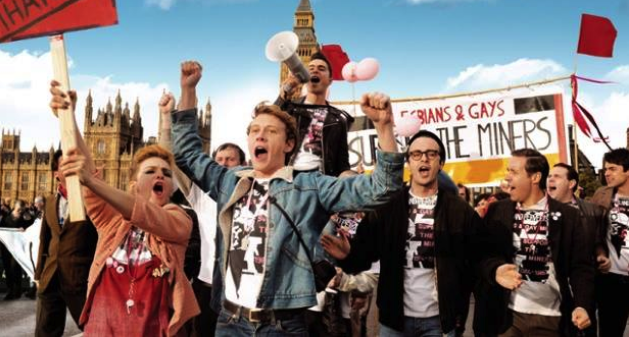
The film follows a group of LGBTQ+ activists who come together to support a Welsh mining community during the UK miners’ strike in 1984.
The group, which calls itself “Lesbians and Gays Support the Miners” (LGSM), initially struggles to find a group of miners who are willing to accept their support. However, they eventually make contact with a small mining village in Wales and begin fundraising to support the miners and their families.
As the relationship between LGSM and the miners develops, both groups begin to understand and appreciate each other’s struggles. The film explores issues of class, identity, and the power of solidarity, as LGSM and the miners work together to fight for their rights.
“Pride” was critically acclaimed upon its release, and was praised for its mix of humor and drama, as well as its positive portrayal of LGBTQ+ characters. The film was also seen as a tribute to the real-life activists who inspired it, and to the power of grassroots activism to effect change.
Did the film “Pride” get good reviews?
Yes, “Pride” received very positive reviews from critics upon its release in 2014. The film has a 93% approval rating on Rotten Tomatoes, based on 169 reviews, with an average rating of 8.0/10. The site’s critical consensus describes the film as “earnest, well-acted, and overall inspirational,” and notes that it “avoids easy clichés and formula.”
Many reviewers praised the film’s mix of humor and drama, as well as its strong ensemble cast. The performances of actors such as Bill Nighy, Imelda Staunton, and Andrew Scott were particularly singled out for praise.
“Pride” was also praised for its positive portrayal of LGBTQ+ characters, and for its exploration of issues of class, identity, and the power of solidarity. Many critics saw the film as a tribute to the real-life activists who inspired it, and as a reminder of the importance of grassroots activism in effecting change.
Overall, “Pride” was widely regarded as a well-crafted and inspiring film that blended comedy and drama, and celebrated the power of community and activism.
Is the film “Pride” based on a true story?
“Pride” is based on a true story. The film depicts the real-life events of the summer of 1984, when a group of lesbian and gay activists formed the group Lesbians and Gays Support the Miners (LGSM) and began raising money to support the striking miners and their families.
The LGSM group consisted of around 20 activists from London, who decided to support the striking miners after recognizing that both groups were fighting for their rights and for a fairer society. The group raised thousands of pounds for the miners, and their efforts were warmly received by some of the mining communities they supported.
The film’s portrayal of the LGSM’s involvement in the miners’ strike is largely accurate, although some elements have been fictionalized for dramatic effect. The film’s characters are also composites of several real-life activists, rather than being based on specific individuals.
Overall, while “Pride” takes some artistic license with the story, it is based on a real and inspiring episode in British history that saw two marginalized groups coming together in solidarity to fight for their rights.
How much did the film Pride make?
The film Pride was hugely successful at the box office in 2014.
According to Box Office Mojo, the film “Pride” grossed approximately $16.4 million worldwide during its theatrical release in 2014.
While this may not seem like a huge amount compared to some Hollywood blockbusters, “Pride” was actually a considerable success for an independent British film. It was made on a relatively modest budget of around £3.3 million, and its strong critical reception and positive word-of-mouth helped to generate a loyal fanbase.
“Pride” was also well-received at various film festivals, winning the Queer Palm award at the Cannes Film Festival and the People’s Choice Award at the Toronto International Film Festival.
Beyond its box office success, “Pride” has also had a lasting cultural impact. The film has been praised for its positive portrayal of LGBTQ+ characters, and for its celebration of the power of solidarity and grassroots activism. It has also helped to raise awareness of the real-life events that inspired it, and has been credited with helping to cement the legacy of the LGSM group and their efforts to support the striking miners.
Margaret Thatcher, the former British Prime Minister, had a mixed record on gay rights.
In the 1980s, she supported Section 28 of the Local Government Act, which prohibited local authorities from promoting homosexuality or presenting it as a “pretended family relationship” in schools. This legislation was widely seen as discriminatory and harmful to the LGBTQ+ community.
However, towards the end of her time as Prime Minister, Thatcher did begin to shift her views on homosexuality. In 1987, she expressed support for a report by the Church of England that called for the decriminalization of homosexuality. And in 1989, she appointed the openly gay Chris Smith as a minister in her government.
(C) BIGSTOCK
It is also worth noting that Thatcher’s government played a significant role in the fight against HIV and AIDS in the 1980s, providing funding for research and treatment, and promoting public awareness campaigns.
Was the Thatcher Government anti-gay?
Thatcher’s government’s support for Section 28 of the Local Government Act, which prohibited local authorities from promoting homosexuality in schools, is often seen as having a harmful impact on LGBTQ+ young people.
Section 28 was introduced in 1988, and it was not repealed until 2003. During that time, many LGBTQ+ children and young people were left without support and resources, as teachers and school administrators were afraid to discuss issues related to sexual orientation and gender identity.
Overall, while Thatcher’s record on gay rights was certainly not perfect, it is not accurate to say that she was uniformly anti-gay. Like many politicians, her views on these issues evolved over time, and her legacy in this area is complex.
The term “gay” can have different meanings depending on the context. However, most commonly, “gay” refers to someone who is primarily attracted to people of the same sex. It is often used as a term to describe homosexuality or the LGBTQ+ community, specifically those who identify as gay.
Table of Contents
Is Being Gay A Choice?
Being gay is not a choice, but rather a natural part of a person’s identity. Respecting and accepting people for who they are is important, regardless of their sexual orientation or gender identity.
It is also important to note that the term “gay” can be used as an adjective to describe things that are related to LGBTQ+ culture or the community as a whole. For example, someone might say “this is a gay-friendly establishment”, to indicate that it is welcoming and supportive of LGBTQ+ people.
When did the term gay replace the word homosexual?
rawpixel.com at Pexels: , most commonly, “gay” refers to someone who is primarily attracted to people of the same sex.
The term “gay” began to gain prominence as a term for homosexuality in the mid-20th century, and it gradually became more common than “homosexual” in the decades that followed. The use of “gay” in this context is believed to have emerged from gay subcultures in urban areas, where it was used as a code word to refer to homosexuality without drawing attention from heterosexuals.
The term “homosexual” has a more clinical and scientific connotation and was commonly used in medical and legal contexts. However, it also had negative connotations and was often associated with mental illness and deviance.
The use of “gay” as a more positive and affirming term for homosexuality gained momentum during the gay rights movement of the 1960s and 1970s, and it eventually became the dominant term used to refer to homosexuality in mainstream society. Today, the term “gay” is widely accepted and has largely replaced “homosexual” as the standard term for same-sex attraction and relationships.
Can only men be gay?
No, both men and women can be gay. The term “gay” refers to a person who is primarily attracted to people of the same gender, regardless of their own gender. So, a man can be gay if he is attracted primarily to other men, and a woman can be gay if she is attracted primarily to other women.
It’s worth noting that some people may use other terms to describe their sexual orientation, such as “lesbian” for women who are primarily attracted to other women, or “queer” as an umbrella term for anyone who doesn’t identify as exclusively heterosexual. However, the term queer is incredibly controversial amongst gay men.
In 2018 only 13% of men surveyed preferred the term queer men and in 2023, that decreased even further to just 8.1%.
Ultimately, the language that people use to describe their sexual orientation is personal and can vary from person to person.
Are gay men different to straight men?
In terms of core human characteristics, gay men and straight men are not fundamentally different. However, there may be some differences in their behaviors, attitudes, and experiences that can be shaped by social and cultural factors, as well as personal experiences.
For example, gay men may face unique challenges related to their sexual orientation, such as discrimination, social stigma, and a lack of legal protections in some regions. These experiences can shape their perceptions of the world and their interactions with others.
On the other hand, gay men may also share some common experiences with other marginalized groups, such as women and people of colour. For example, they may have experienced prejudice and discrimination based on their identity and may have developed resilience and coping mechanisms to navigate these challenges.
Despite these differences, it’s important to recognize that all people, regardless of their sexual orientation, are diverse and multifaceted individuals with unique personalities, experiences, and perspectives.
Have you ever wondered if there is such a thing as a penis too big for a gay man? It’s a question that has long been debated in the gay community, with some claiming that there is no such thing as a “big penis” and others believing that there are limits to how large a penis can be before it becomes uncomfortable. In this blog post, we will discuss the topic of a “big penis” and whether or not there is such a thing as a penis too big for a gay man. We will explore the opinions of both sides and provide insights on the topic.
Table of Contents
The answer may surprise you
When it comes to the size of a penis, not all gay men agree on what is too big. In fact, some gay men even joke about how large penises can be a blessing in disguise. The extra girth and length of a large penis can make it easier for a man to reach new heights of pleasure with his partner. However, it’s important to remember that penis size doesn’t necessarily equate to sexual pleasure, so having an overly large penis may not be the most beneficial thing for a gay man’s sex life.
The pros and cons of a large penis
Are there pros and cons of having a big penis?
When it comes to sex between gay men, the size of a man’s penis can be a source of pleasure and angst. For those who enjoy bottoming, a larger penis can feel better for anal stimulation and prostate play. On the other hand, a larger penis may be more likely to cause an anal fissure or other discomfort. Obviously, there’s the visual aspect, especially when you’re on your knees and a giant phallus is waving in your face, but let’s not forget that big things can become a choking hazard or even can cause significant damage to your throat as one man learned in 2018.
The pros of a large penis include increased stimulation for bottoms during sex. A larger penis can fill up a person more and make it easier to find and stimulate the prostate. This can result in more intense orgasms and longer-lasting pleasure.
On the other hand, there are some drawbacks associated with larger penises. The size may make it more difficult to penetrate, which can cause pain and discomfort. The tightness can also put too much pressure on the anus and a bad session or overdoing it could result in an anal fissure.
In some cases, it may also cause one partner to feel uncomfortable or insecure due to the size difference.
Men with large johnsons can also find themselves viewed solely as sexual objects – and risk becoming fetishised or objectified. Pretty insulting when your cock is just one (proportionally speaking) small part of you.
Ultimately, it’s important to communicate with your partner about size preferences. Experimenting with different positions and using plenty of lube can help to make sex more enjoyable for both partners regardless of size. Finding the right balance between comfort and pleasure is key for having enjoyable sex regardless of penis size.
Tips for dealing with a large penis
If you have a large penis, there are some techniques and tools you can use to make sex more comfortable for both you and your partner. Here are some of our tips:
Use Lube – Lubricant is essential for anal sex and other kinds of penetrative sex. It helps reduce friction and makes it much easier to penetrate without causing pain or discomfort.
Try Different Positions – Some positions are better for people with large penises than others. The missionary position is usually a good choice as the receiver can control the depth of penetration. Other popular positions that work well with a larger penis include doggy style, spooning, and side-by-side.
Use a Dildo or Butt Plug – If you’re not quite ready to penetrate your partner with your own penis, you can use a dildo or butt plug as an alternative. These sex toys come in a variety of sizes and can help you get used to the feeling of something larger.
Take it Slow – Rushing into anal sex or any kind of penetration can be painful or uncomfortable. Take your time and start with some foreplay or other kinds of pleasure before trying to penetrate your partner.
Use Poppers – Poppers are a type of drug that relaxes muscles and increases blood flow, making anal sex more pleasurable for both partners. Just make sure to use them safely and according to the instructions on the bottle. Dealing with a large penis doesn’t have to be intimidating or uncomfortable. With the right knowledge and preparation, you can make sure both you and your partner enjoy the experience.
The psychology behind why some men prefer large cocks
When it comes to gay men and big penises, there is more than meets the eye. For some, a larger penis can represent an increased sense of power and dominance, while the size may symbolize acceptance and belonging for others. But what does this mean when it comes to sex?
Our Sexpert Patrick Devon told us, “For many gay men, the thought of having their anus stretched open by a large penis can be both thrilling and intimidating. This sensation of “gaping” their anus is sometimes is something a lot of bottoms strive for, because it’s seen as a challenge… One they want to excel in!
“While it can be uncomfortable and even painful at times, some gay men find that being dominated and having their ass “wrecked” by a larger penis can be incredibly pleasurable. In some cases, the size of the penis can even become a point of pride among partners, with some people referring to this phenomenon as “size queens.
“And then there’s cock worship. That feeling of taking in something bigger than ourselves… it can be quite a religious moment for many men when they kneel at the church of cock. Sometimes men want to be dominated, made to feel that they are only there to please. It kind of makes sense when you think about it. In society, (now I know this is a generalisation) men are conditioned to be strong, in control and in charge, but what if when you get home you just want to feel a little more subordinate, a little more controlled? Well taking the big penis orally or anally, is definitely one way of giving in to something bigger than you”.
Devon finishes by saying, “Ultimately, it’s important to remember that everyone is different, and not all gay men are necessarily attracted to big penises. Everyone has their own preferences, but understanding why some people might have an affinity for large penises can help us to understand our own desires better.”
Links in this article may take you to a shopping channel that is owned by our parent company. Other shops and brands are available.